“The pleasure of reading a story and wondering what will come next for the hero is a pleasure that has lasted for centuries and, I think, will always be with us.”
— Stan Lee
Back in 1985, when I was 13, my brother and some of his friends started playing a table top role-playing game called Villains & Vigilantes. It was D&D’s heyday and if your game’s title didn’t have an ampersand and alliteration, were you even trying to make an RPG? I usually wasn’t allowed to play with his RPG groups, but I always got to flip through his rulebooks and supplements. When I cracked open the V&V rulebook, I had no idea that I would still be playing this game 34 years later. I couldn’t even imagine graduating high school–at that point it seemed too far away. Minutes seemed hours and years seemed infinite when I was a kid. Inside the book I discovered that you could play as yourself. Instead of creating a secret identity for your character, you were your secret identity! I was immediately hooked and begged my brother to let me make up a character. I remember being nervous about rolling up my Powers at random, hoping they would be really cool or at least similar to those of my favorite heroes: Daredevil and Spider-Man. I ended up with a strange mix of powers that didn’t go together at all. The rules suggested that you find a theme within your Powers and get rid of the rest, but I refused. I don’t remember why. Maybe it was the beginnings of my tendency to “Power Game” or maybe I was afraid of not having the right ability for every situation. My brother was frustrated but allowed Mega Man (even to this day the name embarrasses me) to exist. The flame powers of the Human Torch, the agility of Spider-Man, the telepathy of Professor X, the phasing of Kitty Pride, the intelligence of Reed Richards, and the growth of Giant Man. After some more begging, I got to play in the adventure ‘Crisis at Crusader Citadel’ alongside some of my brother’s friends. It’s a simple two act module meant to introduce the players the the V&V Universe through a group of A-List vigilantes–the Crusaders, and their villainous opponents–the Crushers. It was surprisingly fun and original. Mega Man got to strut his goofy stuff, firing flame blasts, phasing through walls and floors, and acting as a telepathic switchboard for the entire team. All of the villains and heroes we fought against or beside are just as indelible in my memory as my favorite Marvel and DC characters, and it’s still the first adventure my new players go through when I start a campaign. It will always be one of my fondest memories of playing a TTRPG. I played V&V for the next three years straight introducing my small circle of friends to it, and running my own games. Mega Man was on the bench and would always be now that I was the GM. Sadly I would step away from the game for decades. Then something happened in 2015.
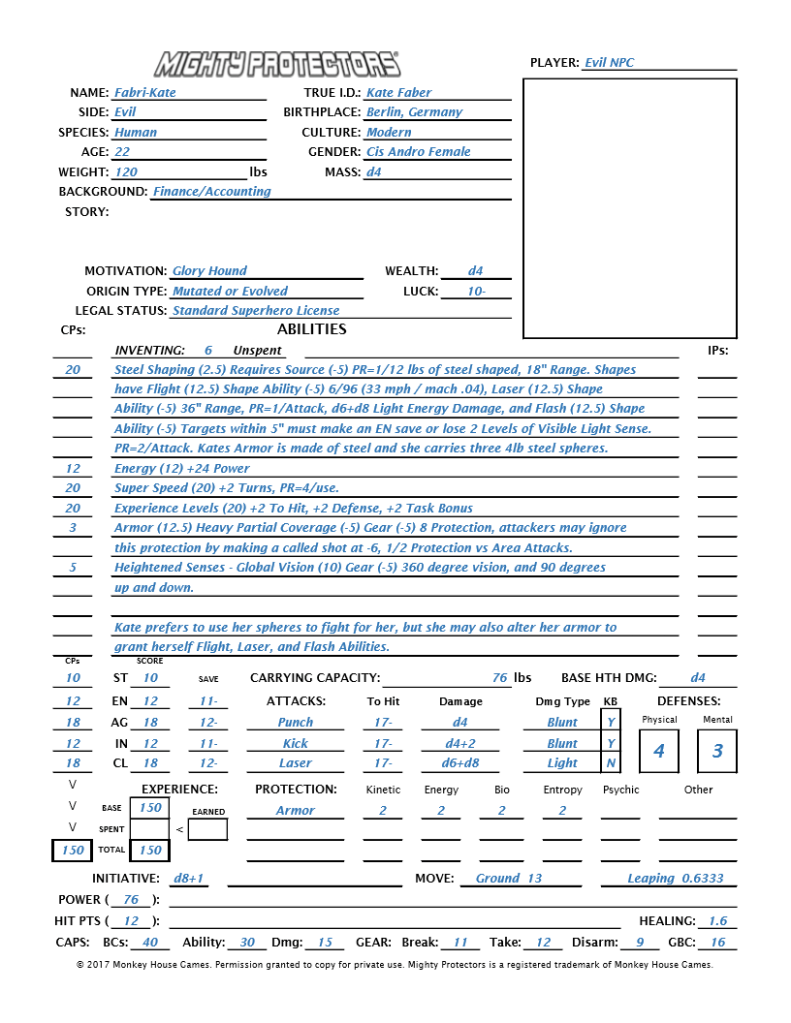
I don’t have an interesting backstory for this character. Probably because I didn’t randomly roll them up. When I create a character randomly I’m usually get inspiration during the process. This character is simply an exercise to see how far I can push various abilities within the V&V system. For this character I chose Shaping. Shaping allows a character to create and/or shape and manipulate a form of matter–in this case, steel. The interesting part to me is that these ‘Shapes’ can be given their own Abilities and can receive Actions during combat. There were a few hurdles to overcome to make this interesting and effective. Firstly, to give an Action to a Shape you have to have one. I want Fabri-Kate to be able to manipulate multiple shapes, so I gave her Super Speed which grants extra Actions each Turn. Shaping also requires Line of Sight to your Shapes or they dissipate. To counter this handicap I chose Heightened Senses: ‘Global Vision’ so that Kate can see 360 degrees around themself. Lastly, Shaping is extremely Power hungry, so I chose Energy which grants increased Power which is the resource characters use to fuel their Abilities. The rest of the Abilities are chosen for protection. Meet ‘Fabri-Kate’.
Fabri-Kate, mistress of fabrication–naturally.
So how does Fabri-Kate fight? They animate their steel spheres granting them the Flight, Laser, and Flash Abilities. They can move about, shoot, and emit blinding flashes of light to temporarily blind foes. Kate can also use Shaping on her suit of armor to use these Abilities., but prefers to let the little spheres of death do it. I keep thinking this character would be a lot of fun to draw, but never seem to get around to it.
Paul was a humble social worker and teacher at an alternative school for disadvantaged youth. One day Paul tackled a shooter that had attacked the school, saving the lives of his students and the other faculty. Suddenly he was getting his 15 minutes of fame. There was an award ceremony with the mayor of L.A. and he did some interviews and TV apprearances. A few weeks after the fervor died down he was approached by eccentric millionaire Frank Shim. Shim said he had been looking for someone like Paul for years. Someone to wear his armor and take up the mantle of his superhero persona–the Pistol Shrimp. Shim had made his millions with his miniaturization technology, and some questionable weapons contracts with the U.S. Government. Paul was reluctant but eventually gave in an accepted the hi-tech suit of armor. He’s been fighting crime in and around LA for some time now. Ever the progressive, his favorite thing to do is show up to protests to ensure that no violence breaks out, on either side of the thin blue line.
Summary: The idea is to create a new character every day for the month of January. It doesn’t matter what RPG system you use, or if you use the same one or many different ones. The points is to get more familiar with the mechanics of games you have an interest in by creating characters. I’m 18 days late to the challenge, but I’m going to give it my best. I’m starting out with a villain I randomly generated using the Villains and Vigilantes 3.0 rules (aka Mighty Protectors). Meet the Geminator:
The Geminator
Castor was caught in a freak lightning storm that struck him down. When he awoke he was face to face with an exact copy of himself. They fought discovering their superhuman ability to control electricity, fly and move at super speeds. The fight lasted for hours due to the twins ability to gain energy from the very air around them. It ended with one absorbing the other in a flash of lightning. Castor was reluctant to summon his clone again, but the more he tested his abilities and turned them to selfish ends, the more help he needed. He would always reluctantly summon his duplicate and there was always a fight or an argument about who the real Castor was. Sometimes they would sulk for days only to have one ambush the other and reabsorb them. Who was the real Castor–and who was the fake. Neither of them know for sure. When I randomly rolled Phobia as one of his two Weaknesses, I thought it would be compelling to give this character a fear of his other self. This creates a chaotic and unrelaible character, much like the unpredictable nature of lightning itself.
Welcome to the fifth character build guide. I know this is a niche RPG and as such, I’m not getting a lot of traffic to this blog, but if you are reading and enjoying these guides, please leave a comment and let me know what’s working for you, what isn’t, and what you’d like to see. Let’s get started on the build. In modern gaming terms a Support class or character is someone that heals, protects, or enhances the abilities and effectiveness of their allies. Comics have had their fair share of characters with healing abilities, but I was having a hard time finding heroes that are purely built for support. This being the case, I looked at the V&V 3.0 Abilities for inspiration, and to one of my players whose character Lodestar is one of the most tightly designed in our entire campaign. Unfortunately, he’s currently in a coma under the care of the Crusaders. That’s what happens when you’re so effective—the villains tend to focus on you to your detriment. Lodestar was built to heal and protect his allies, but it’s how he does it that’s so slick. He does this—correction, did this—by exploiting Teleportation. With the Teleportation Modifier “Beam” he used it to teleport dangerous villains away or bring allies close to him where he could then use Healing. Teleportation takes place during Movement which saved his Action for Healing or creating Force Bubbles. In addition to his support, he had one offensive tool—the humble but very effective Power Blast. This meant that no matter what the situation was, Lodestar was always contributing something—mobility, protection, healing, or damage. Entire fights would pivot on his versatility and this made his character the ultimate Support in my eyes. Until now.
You see, V&V 3.0 introduced Ability Modifiers. These allow players to customize their Abilities in ways that make them totally unique, flavorful, and useful in ways that they might not have considered. One that jumped out at me when I was creating the Support character for this guide was Reversible. A Reversible Ability is one “…that can also produce the opposite effect (for example, an Electrical Bolt that can be used to inflict or heal Electrical Energy damage)” for the cost of 10 CPs. Speaking of healing, I’m gonna be honest here. Some of the Abilities as written are total stinkers, and Healing is probably one of the worst. Even with a whopping 20 CP investment you can only heal 2 Hit Points (4 if you Push), and it takes an entire Round. As soon as I saw Reversible, I flipped to one of the most powerful Abilities in the book—Siphon. Sure enough, Reversible makes this Ability better than Healing in every way. 10 CPs in Siphon with +10 more spent on Reversible has the same Range as Healing, but costs zero Power and can inflict 2d4 damage or heal 2d4 Hit Points. As I’ve said before, a Standard Power level hero—which is what I tend to build the most—has an Ability Cap of 20 CPs. So, with that in mind I started looking for other Abilities that are still powerful with only a 10 CP investment. Devitalization Ray is one such Ability. At 10 CPs it inflicts a staggering 2d8+d10 Power damage. A couple of hits can quickly shut down a target’s Abilities, and leaves them without a way to Push, or ‘Roll With’ Damage or Save Attacks. With the Reversible Modifier, Devitalization Ray perfectly fits our Support mold, replenishing buckets of Power to your allies.
As I’ve said before, I’m a huge fan of Lodestar’s design, and they say imitation is the sincerest form of flattery so I’m going to pick up Force Field, and Teleport. I’ve seen firsthand how Power hungry his build is, so I’m also buying Energy. For defense and utility, I’m going to the well to pick up some Armor and Heightened Expertise. Here are our Abilities and their Modifiers:
Siphon w/ Reversible
Devitalization Ray w/ Reversible
Force Field w/ Area Effect – Perimeter, Moves with Self,
Reduced PR, and Does Not Block Teleportation
Teleport w/ Beam
Energy w/ Gear
Armorw/ Gear and Light Partial Coverage
Heightened Expertise
Weaknesses:
Compulsion: Rejuvenator always puts the safety of others above her own.
The idea is to have a character that can not only replenish Hit Points, but Power as well which is arguably more valuable when you think about it. It’s used to fuel your Abilities, Push past your normal limits, and ‘Roll With’ Damaging and Save Attacks. Every point of Power represents offense, defense, damage mitigation, and resistance. I would argue that this version of Devitalization Ray is even more important than healing in most situations. Enough pontificating–I’m going to go do some min-maxing and then I’ll be back.
Introducing Rejuvenator!
Rejuvenator’s tactics focus on depleting her foes Power to end fights early thus preventing as much damage as possible. She always puts the health and well-being of her teammates above her own, teleporting them out of danger, healing them, or protecting them with Force Bubbles which she can carry and drop where needed. Her only offensive tool is Siphon, which has a range of Touch. While she does have protective Armor, getting into melee should be a last resort. Lastly, she has Heightened Expertise to increase her overall effectiveness in combat. I hope you found this guide helpful, and please feel free to submit your character build ideas or requests in the comments.
Let’s cut to the chase, because this build is all about speed. The Speedster has been around since the 40s with the creation of the Flash, and later Quicksilver, Whizzer, Speed Demon, and so on. To me, a Speedster’s role is to even the odds by taking extra Turns each Round and using their increased movement rate to allow them to be everywhere at once. It’s akin to having two or three extra heroes on the battlefield. First let’s review the best Abilities a Speedster can buy: Super Speed (for extra turns), Speed (increased movement rate), Heightened Initiative, and Heightened Cool. Recommended Ability Modifiers are: Activation Power, Reduced Power Cost, Fast Acceleration, Water Running, and Body Part. While this archetype might seem very straightforward, there’s no reason we can’t take it in a new direction.
My concept for this Speedster is an unstoppable pursuer that
isn’t hindered by the usual obstacles. V&V has no shortage of mobility
Abilities, and while most V&V veterans think of Flight and Teleportation as
being the premier ways to get around the battlefield, they would be mistaken. When
your character can run nearly 200 miles per hour across water and up walls or
through them, those other modes of travel will seem a bit tame. I’ll start with
the core of our build. These Abilities are non-negotiable, and as such they
will be maxed out at 20 CPs for this Standard Level hero.
Next, I’m going to fill out my character’s “Go Anywhere”
suite of Abilities and Modifiers before moving on to offensive and defensive
powers. The Speed modifier “Water Running” allows the character to run across
the surface of liquids and the Physical Ability “Wall Crawling” allows our
character to travel along sheer vertical or inverted surfaces; a bargain at
only 5 CPs. That covers up and over, but what about through? That’s where
Tunneling comes in. Tunneling allows a character to move through solids by
opening a tunnel in front of them. The maximum SR (Structural Rating) of matter
that the character can tunnel through is determined by how many CPs they spend,
as is their maximum tunneling speed. Lastly, there is a Tunneling Damage bonus
that you may apply to one of your character’s Attack Abilities. My Speedster
digs with her hands, so I’m associating this bonus with their unarmed Punch
attack. Let’s look at our Abilities thus far:
Super Speed
Speed
Wall-Crawling
Tunneling
Now that we have our mobility worked out, we need some offense,
defense, and utility. With the Tunneling Damage bonus to her unarmed Punches
she has a good offense, but I want to make sure she can land those hits. I’m
choosing to go with Heightened Expertise. Normally I would choose Natural
Weaponry, but we already have extra damage. The Power cost of her Super Speed
is rather steep, and I want her to be able to Push her Punch damage and Tunneling
Speed, so I’m choosing Armor for defense. It provides a good amount of flat
damage reduction at no Power cost. For utility I want to support her Super
Speed and Tunneling. Heightened Initiative grants a bonus to every Initiative
Roll, and when you get three Turns per Round (three Initiative Rolls), this
bonus is effectively tripled! Lastly, I don’t want her tunneling blindly with
no idea where her quarry is, so she’s getting some X-ray specs in the form of
Heightened Senses penetrating vision. Here’s the final loadout, Core Abilities
in Bold as usual:
Super Speed with the Activation Power
modifier. This doubles the cost of an Ability, but after the initial
Activation, it costs 0 Power to use. If a combat lasts more than two Rounds,
this Ability will pay for itself.
Speed with the Body Part modifier (I’m
choosing legs, naturally) which refunds 5 CPs, which I’m spending on both Water
Running (2.5 CPs) and Fast Acceleration (also 2.5 CPs). This allows
my character to move across the surface of liquids and doubles their
Acceleration Rate to 256”/Turn. Eat your heart out, Teleportation.
Wall-Crawling
Tunneling
Heightened Expertise
Heightened Initiative
Heightened Senses – Penetrating Vision with the Gear
Modifier.
Armor with the Gear, Ablative, and Heavy Partial
Coverage modifiers for a whopping 15 CP refund. Gear makes her armor
breakable, Ablative causes it to lose Protection as it’s damaged, and Heavy Partial
Coverage allows her enemies to ignore her armor by making a called shot at -6 To
Hit, and it only provides ½ protection vs Area Effect Attacks. These may seem
like large disadvantages but being able to max out her Protection is worth it.
Weaknesses: Can’t Hold Back because she never learned to
pull her punches, and Compulsion—if she has Power left, she won’t stop chasing
her quarry until she captures them or collapses from exhaustion.
I’ll go run the numbers and be back in a flash. Let’s meet Pursuer, the Speedster.
A former Ultimate Fighting Champ, Sue lost the use of her legs when she suffered a spinal injury at the hands of a bookie and his thugs when she refused to throw a fight. When she heard that Manning Enterprises had opened human trials for an experimental drug that might restore her ability to walk, she immediately signed up. She regained the use of her legs but also gained superhuman Abilities, which got the attention of the Crusaders—the local superhero team. There she received training, along with her armor and x-ray goggles. When she fought professionally, she was known as a fierce and tenacious opponent and her crime fighting style is no different. With a top speed of 174 miles per hour she isn’t going to be beating the Mercury Mercenary in a foot race, but she can run across water (or any other liquid), on vertical or inverted surfaces, and she can see through and tunnel through nearly any material. This makes her a nightmare for the cowardly villains who would try to evade justice, and her fists.
Welcome to my third character build guide. This time we’re
focusing on the master of the battlefield—the Controller. Comic book characters
like Ice Man, Cable, and Graviton are great examples of this archetype. A
Controller’s role is to incapacitate their enemies, de-buff them, and
well—control them. Key Abilities for a Controller are: Darkness Control,
Devitalization Ray, Emotion Control, Grapnel, Gravity Control, Ice Blast, Mind
Control, Paralysis Ray, Paralytic Poison, Siphon, Telekinesis, and
Transmutation. I highly recommend the following Ability Modifiers: Area Effect,
Duration, and Success Power. There are more ways to play a Controller than any
other archetype, but like the others builds it pays to remain focused. I would
strongly suggest building around one controlling Ability—two at the most. All
your other Abilities should either support your choice of Control or provide
you with some utility and protection so you can stay in the fight long enough
to be effective. With that in mind, I’ll start with the Control Ability—Gravity
Control.
In V&V, much as in real life, Gravity is O.P. It can bring down the biggest and toughest foes you’ll face, and it’s very hard to protect against. Even if a target doesn’t take much damage, they’ll still be lying on their back staring at the sky (or ceiling) and thinking about that time they were upright and mobile. Those were good times, they might think—I should have appreciated them more. Anyway, let’s dive into Gravity Control—just like things with a lot of uh, gravity—the mechanics are very dense and need some unpacking. To quote the rules, Gravity Control are a set of Abilities that “enable a character to modify the pull of gravity on objects or areas. There are three forms of Gravity Control: Gravity Decrease, Gravity Increase, and Personal Gravity Well.” The first version allows you to make a target weightless or even fall upward, the second allows you to make a target weigh more thus pinning them to the ground, and the third is a kind of gravitational distortion that makes you harder to hit. I’m choosing to focus on Gravity Increase. While I think it’s funny to make someone fall upward for a while, the subsequent fall seems cruel, and this is a superhero I’m designing.
To make Gravity Increase better, we need to understand how
it works exactly. First off, it’s a Voluntary Attack Ability with a range of ST
(Strength) and it covers a 1” square. The multiplier to the weight of targets
within the affected area depends on your CPs in Gravity Increase. For example,
if you have 20 CPs in Gravity Increase, you multiply the weight of your target
by eight. If their new weight exceeds their carrying capacity, they are pinned
and dealt kinetic damage equal to their new Mass Roll minus their HTH Damage Roll.
There’s a bit of a unique twist to Gravity Increase, and this is where the
build gets interesting. Remember Pushing? Yeah—that thing where you spend 2
Power to do things like gain a +2 damage bonus, double your maximum speed, or
gain a Save bonus? Well, forget that measly +2 bonus or multiplier. Where this Ability
is concerned “Pushing increases the Weight Multiplier by a factor of (Power Spent
+2)! “So?” you might say “2 power for Pushing + 2 = 4, times 8 = 32”, and you’d
be right. Unless we have Willpower C) Self-Control, which allows you to Push
for more than the normal amount—a lot more. For example, if you have 10 CPs in
Self-Control, you get a +4 bonus to Pushing for the cost of 4 additional Power.
So now you’re pushing for a total of (6 + 2) times 8 =
64! This makes your Gravity Increase effective against even the strongest
targets, meaning you don’t have to be content to smush small fry into the dirt.
Moving on to the other support Abilities.
Gravity increase costs 3 Power to use, and to maintain. If we’re going to be pushing for more than the normal amount, we’re gonna need some Power. Let’s grab Energy, which gives us 2 extra Power for each CP we spend. Twenty CPs gives us 40 extra Power to play with, allowing us to Push our Gravity Increase to awesome limits. Let’s review our Abilities so far:
Gravity Control B) Gravity Increase
Energy
Willpower C) Self-Control
There are couple of build directions that
present themselves: Find other Abilities we can dump ludicrous amounts of Power
into, or make sure we don’t get pasted by the first villain that turns their
attentions on us. Both? Both. Monkey House Games recently added some Abilities
to the official rules, and there just so happens to be one that benefits from our
Willpower Pushing Bonus. Inertia. I know this article is getting long but stick
with me—this is a sweet build. Inertia is an attack that reduces the movement
rates of characters and vehicles by applying a divisor. As usual, the divisor
is based on your CPs in this Ability. However, you can increase the divisor by
Pushing, adding the extra Power spent directly to it. Inertia makes the cut.
Even if we don’t invest many CPs into it, our Willpower will more than make up
for it.
Let’s get this hero some Defensive Abilities before they get pounded. Our Tank was tough as nails, and our Blaster was evasive, so I want to mix it up a little bit. I like the theme we have going so far, and I want to expand on it. We have a hero that can tap into unseen forces to manipulate gravity and slow enemies to a crawl, so I’m going with Force Field. I’ll spare you the description as this Ability is straightforward—you wrap yourself in an invisible Force Field that deflects damage. It’s Power-hungry, but our hero can handle it.
Lastly, we want to hit as often as
possible with our Gravity Control and Inertia. Normally I would grab Heightened
Expertise, but this time I’m going with Heightened Agility. It raises our hero’s
Physical Defense, To Hit chance, and gives them a healthy chunk of Power.
Sometimes the best choices are a little boring. Inventory time:
Gravity Control
Willpower C) Self-Control
Inertia
Energy
Force Field
Heightened Agility
Just as before, our Core Abilities are in
bold—those are the ones we’re allowed to start at 20 CPs. I’m going to go apply
some modifiers and Weaknesses, and then I’ll be back with our hero…
Introducing, Gravitas!
Gravitas is a young mutant with the power to manipulate Earth’s gravitational field. He is able to slow or even pin his enemies in place or use this force to shroud himself in a protective barrier. His will to do good and protect the innocent provides him with a deep well of energy that fuels his powerful abilities. I hope you liked this build guide. If you did, please let me know. If you didn’t, I’m impressed that you read this far. See you next time.
While going through a
storage unit back in Fall of 2016, I stumbled on my copy of V&V 2.0 and a
stack of adventure modules. I was immediately brought back to 1985 and images
of Mega Man’s adventures flooded my imagination. However, without a regular
group to play with, I brought my books home, stuck them in a drawer, and didn’t
think about them until Spring of the following year. In 2017 I discovered a
browser-based tabletop simulator called Roll20, and suddenly got the itch to
play something—anything to get back into TTRPGs. I had recently become part of
an online gaming community—a small but very friendly Discord Server that belonged
to a friend of mine. My first thought was to reach out to some of the other
members to see if anyone was interested in trying to mount an online campaign.
I was happily surprised to get over half a dozen responses, and our RPG Chat
channel was born. There I spent time talking to my future players about the
virtues of V&V–trying hard to sell a decades old RPG that none of them had
ever heard of. I snagged a PDF copy of the 2.1 rules (which really went a long
way to clearing up some of the murkier corners of the game’s mechanics) and an
updated character sheet. Everyone started generating characters, and I was
buzzing with the possibilities of a blank canvas–a new campaign and a fresh
group of players!
V&V (pre-Mighty Protectors) is a harsh mistress. You roll a d6+2 to see how many Powers you get, and then randomize said Powers, plus one Weakness. You must discard one Power immediately, and if you want to get rid of your Weakness, you have to discard another. It goes without saying that finding a theme within those oddments is a challenge. However, in Mighty Protectors they remedied this by allowing all players to roll six Powers (now called Abilities), and encouraging them to pick up two Offensive, two Defensive, and two Miscellaneous to round out their character. I was excited at the prospect of helping my players update their characters. The lucky few who had a lot of Powers might lose one or two, but the ones that rolled poorly were in for a treat.
While our 2.1 campaign progressed, I was planning our transition to V&V 3.0 behind the scenes—trying my best to master the character creation process and familiarize myself with the updated combat system. My players were currently fighting their way through the classic Crisis at Crusader Citadel—teaming up with the Crusaders and facing off against the hated Crushers. It was a great hit of nostalgia, but I wanted a meaningful next step for them. When I played V&V it was less of a campaign and more of a series of combat-heavy episodes that had no overarching narrative. While reading the Guide to the Multiverse section of V&V 3.0, I came across the Crusaders entry. Jeff and Jack saw them moving on and forming an Academy for up-and-coming heroes. I found the foundation upon which to build my campaign. My players were going to school. (to be continued)
This is the second in a series of articles for V&V 3.0 focusing on building character archetypes. I want to reiterate that these guides are for players who are already familiar with V&V 3.0, and that my ideas of how each archetype should play are a mix of what I’ve seen in comics, other TTRPGs, and my own opinions and personal play style. Moving on. The Blaster has been around since the dawn of comics in one form or another—Cyclops of the X-Men (1963), and Black Lightning (1977) are great examples. A Blaster’s role is to deal high damage at medium to long range with a high degree of accuracy. Some useful abilities for the Blaster are: Disintegration Ray, Electrical Bolt, Flame Blast, Heightened Expertise, Laser, Power Blast, Repulsion Blast, Sonic Blast, Special Weapon, Telekinesis, and Vibratory Blast. As for Ability Modifiers, I highly recommend the following: Area Effect, Armor Piercing, Autofire, Activation Power, Focused, Increased Duration, Different Damage Type, and Reduced PR.
When most people think of a primary damage dealer, they think
of D&D’s Evocation Wizards, Sorcerers, Rogues, Rangers, and terms like
Glass Cannon and DPS come up. In V&V combat flows differently than most
TTRPGs—they can be over very quickly, or drag on as the offense of one side
struggles vs the defensive powers of the other. With so many Abilities, and so
many options in combat it’s hard to pin down a target if they play
intelligently, and there are plenty of Defensive Abilities that can mitigate or
even shut down incoming damage. So how do we make sure our Blaster is good at
her job? While you can’t account for everything, you can at least make sure
you’re hitting often, dealing consistent damage, and bypassing some of the more
common defenses. Unlike the Tank, we’re going to start with our Offensive options.
The Blaster is concerned with Damage Types more than any other archetype. In V&V there are Full, Sub, and Specific Damage Types. For instance, Energy is a Full Damage Type, while its Sub-Types are broken down into Electromagnetic, Energy Beam, High Temperature, Light, and Radiation, which are broken down even further into Specific types like Electrical Shock and Flames. We’re not too concerned with the Sub and Specific types as much as we are Full, because most Protection will mitigate a Full damage type. The most common types of Protection you will run into are vs. Kinetic and Energy damage. Yes—Armor, Ice Armor, and Force Field offer flat damage reduction across four Full Types, but the most potent Protection Abilities like Invulnerability and Absorption Protection usually focus on one or two. In my experience, the least common type of Protection is Psychic. There just aren’t a lot of Abilities that deal Psychic damage, which is where the most potent Ability Modifier for our Blaster comes into play, and that is Different Damage Type.
If you flip to page 89 of your Mighty Protectors manual,
you’ll see Different Damage Type on the top right. It states that “This changes
an attack Ability’s damage type. There may be an additional charge depending on
whether the new damage type is more (or less) expensive. Notice that there is
no point cost for changing the damage type of an Attack Ability among Kinetic,
Energy, Bio, or Entropy. However, there is a 5 point cost for changing it to
Psychic and a 10 point cost for changing it to Other. That’s because these two
damage types are hard to defend against. Let’s start by building our “Primary
Nuke.”
Power Blast. Has there ever been a simpler and more iconic
V&V Ability? I don’t think so. For the paltry cost of 1 Power you can deal
double digit damage. In a game where non-superpowered crooks and criminals have
an average of 5 Hit Points, this makes dealing with street crime a breeze.
Verses other superpowered individuals, it’s still a potent offensive tool,
requiring only a couple of well-placed blasts to take down most opponents.
We’ll get into the build later, but just so you know, I’m buying Different
Damage Type ‘Psychic’ as my first Ability Modifier.
Now we need to make sure we hit often and stay out of
trouble. Normally I would go with Heightened Agility because you get the
benefit of increased To Hit, Defense, Power, and Hit Points, but a Blaster
should be fighting at a distance. This build really doesn’t need that much
Power to function, so I’m going to go with Heightened Expertise and Heightened
Defense. These powers in combination make her both accurate and evasive. To help
her keep her distance, I’m choosing Flight because it’s useful for staying out
of harm’s way, and for getting line of sight to targets that are using hard
cover. Lastly, I’m going to invest in some Protection as you never know when a
lucky roll will overcome her defenses. Armor is a great choice here, and I’m
going to apply some modifiers to make it cheaper. Let’s look at our Ability
list:
Power Blast – Modifiers: Different Damage Type ‘Psychic’,
Body Part (Eyes)
Heightened Expertise
Heightened Defense
Flight
Armor – Modifiers: Gear, Light Partial Coverage
Our core Abilities are in bold. As a Standard Power Level
character, we may spend a maximum of 20 CPs in our four Core Abilities. As
always, some weaknesses help round out our character, and refund some points so
we’ll have enough to finish our build.
Farsighted – Has only Basic Vision within a range of 5″
Now that all the details have been worked out, let’s meet
Farsight! *rimshot*
I’ve engaged in a little min-maxing, but nothing outside of our theme and nothing too overly powerful. I was able to afford 20 Points in Power Blast and change its damage type to Psychic (5 CPs) by applying the “Body Part” Ability Modifier for a 5 CP refund. This does means that a hit to her eyes could potentially disable her Power Blast, but an attacker would suffer a -6 for the Called Shot. Add this to her Physical Defense of 6 and a Called Shot to her eyes would suffer a total of -12 making it highly unlikely. Farsight can use Flight to stay at maximum range (12″ or 60 feet), nullifying the threat of melee opponents, and making her even harder to hit, while suffering little from the reciprocal Range Difficulty penalty. She even has decent Protection in the form of some light armor that I maximized using the Gear and Light Coverage modifiers. I even shuffled some of the Protection points around to afford her some Psychic Protection as that’s her only real blind spot in terms of defenses. Her Farsighted Weakness is flavorful without handicapping her too badly—she is supposed to stay out of close range after all, plus the wordplay was too good to pass up. 😛
Our Blaster is finished! She’s accurate, deals moderate to high damage, she’s very mobile, and hard to hit. There are so many ways to go with this archetype it’s staggering. V&V has no shortage of ranged attack options, mobility powers, and modifiers that help with your damage output.
This is the first of a series of articles for V&V 3.0
focusing on specific archetypal character builds or roles. While V&V has no
class roles, that doesn’t stop people from wanting to play Tanks, Healers, DPS,
Support, Controllers, Speedsters, etc. This desire might come from the comfort
and familiarity that other TTRPGs character classes offer, or it could come
from the original inspiration for superhero RPGs themselves—the comic books
that introduced us to the genre. No matter where it comes from, it’s worth
nurturing because it helps flesh out the identity and motivation of a player’s hero
and helps to get them into character. Since it’s not entirely obvious how to
mimic all the classic class roles using V&V, I’ll outline some system
specific ways we can accomplish our goal.
Enter, the Tank:
When most players think of a Tank, they imagine her being
durable—able to take a ton of punishment for her teammates. The problem with
TTRPGs is that you will need to force enemies to attack your Tank. If you’re
extremely tough, then they will likely turn their attention to softer targets.
That’s why every great Tank has a Taunt—an ability that forces enemies to focus
on them. In V&V, that ability is Emotion Control.
Emotion Control is a Psychic Save Attack. In V&V terms,
this means that targets hit by it get to roll to resist its effects. In TTRPGs
this is commonly known as a Save, Saving Throw, or Save Roll. As this will be
the ability that defines our Tank build, we need to make sure it hits, and that
the target fails their Save. We can do that with other Abilities like
Heightened Expertise to gain a bonus To Hit with Emotion Control, and Willpower
C) Self-Control which will allow you to Push to impose a greater Save Penalty
on your target. Self-Control is also a handy ability in a pinch allowing you to
run faster, lift more, and hit harder. Sounds like a great Tank power!
So, we have Emotion Control, Heightened Expertise, and Willpower C) Self-Control. There are many ways to go from here, but now that we have our utility abilities out of the way, we should focus on defensive and offensive abilities. V&V smartly suggests that all characters roll or choose two offensive abilities, two defensive abilities, and two miscellaneous abilities. This makes your hero well rounded—able to deal damage, survive, and perform some other useful tasks. There are dozens of abilities to choose from, but I’m going to narrow it down into three styles of Tanking—the Evasive Tank, Thorn Tank, and The Brick. Let’s start with the Defensive Abilities.
The Evasive Tank aims to avoid being hit. Some useful Abilities for an Evasive Tank are: Glare, Heightened Agility, Heightened Defense, Non-Corporealness, and Teleportation. The Thorn Tank uses Ability Fields to deal damage back to their attackers when they are hit. Useful Abilities for Thorn Tanks are: Chemical Body, Disintegration Field, Electrical Field, Flame Aura, and Reflection. While the first two types of Tanks can be fun and interactive, I’ll be building The Brick. What can I say, I like the classics. Useful Abilities for The Brick are: Absorption, Armor, Density Change, Durability, Energy, Force Field, Heightened Endurance, Invulnerability, Regeneration, Shield, and Stretching Abilities.
I’m going to go with Armor and Heightened Endurance. Armor provides a flat damage reduction against the most common types of attacks, while Heightened Endurance gives our Hit Points a nice boost while also adding a hefty chunk to our Power score which we’ll need to fuel our Emotion Control, Willpower, Pushing, and to Roll With damage. Now on to our Offensive Abilities. It is very likely that the targets we have goaded into attacking us have some way to attack us from range. Therefore, I’m skipping making a list and I’m going straight for a longtime V&V staple—Power Blast. Its Power cost is low, and it deals respectable damage. Wait. What? You want to punch things? Fair enough. Some useful Close Combat Offensive Abilities for The Brick are: Heightened Expertise, Heightened Attack, Natural Weaponry, Poison, Siphon, and Stretching Abilities. Actually—now that I think of it, Stretching Abilities offers some great utility and defense, while allowing you to punch things at range. Ok—new plan! We’re going with Natural Weaponry and Stretching Abilities, and we’re ditching Armor. This Brick malleable! Let’s look at our creation so far, keeping in mind this is a Standard Power Level hero. That’s 150 CPs (Character Points), eighty of which will go into our Abilities, while the remaining 70 will go into our BCs.
I’ve used bold text to indicate which of our Abilities are
our Core Abilities. In V&V a new character may have up to four Core
Abilities which may start at 10, 20, or 30 CPs for Low, Standard, and
High Power Level characters respectively.
The other Abilities must have less than 20 CPs allotted to them. To get
some points back, and add some flavor to our hero, we’ll be adding some
Weaknesses:
Can’t Feel Pain – “Pain don’t hurt” –Dalton
Compulsion – Our Brick must always challenge the toughest
enemy and may not flee.
After some creative use of modifiers and tweaking of numbers
and stats, I give you…
THE PLIABLE MAN!
Gaze at his gelatinous glory. To shave some points from his Emotion Control I applied the “Single Emotion” and “Requires Speech” modifiers. I feel like every good Tank should have to shout to get their opponents’ attentions, and he only needs to focus on one emotion, rather than a broad spectrum. After all, he just needs to make enemies focus on himself. As you can see, he has plenty of Power and Hit points, increased accuracy with his Emotion Control and melee attacks, and the ability to punch targets up to 6” (30 feet) away! He has the added utility of being able to ooze through small cracks, and his Plasticity gives him a whopping 9 Kinetic Protection! Finally, his Willpower lets him Push for a -4 to a target’s Save, +4 to his own Saves, +4 damage, x4 Carrying Capacity, or x4 Movement Rate. On the downside, it costs 4 Power, so use it sparingly.
Our Tank is complete. He has a Taunt, he’s extremely
durable, and he’s a capable fighter with some added utility. I hope you enjoyed
this character build article. Please check back as I will be creating more,
specifically: The Blaster, the Controller, the Support, the Speedster, and the
Infiltrator.
As I said before, the first time I played V&V (2.0) I
was thirteen years old. I didn’t understand what made a game system good or
bad, difficult or easy—all I knew is whether it was fun or not. V&V was
just fun. It ticked a lot of boxes for me—you could play as yourself (stats to
be determined by you, your overly critical friends, and the GM), you got a totally
random set of super powers, and you got to blast bad guys and send them flying.
Many of the Powers were open to interpretation, which was good if your GM was
on top of things. A lot of the Powers simply asked you to make something up,
which was also good—again, if your GM was helpful and understood balance within
their campaign. There were some Powers that were just plain broken, such as: a
type of Illusions that allowed you to create a near endless horde of hard-light
minions, Teleportation which could potentially allow you to travel several
lightyears in an instant, and Gravity Control which could multiply the weight
of a target many hundreds of times turning them into jelly. You get the idea.
There we no caps, no limits—just your imagination and your GM’s willingness to
reign it in, or let it run free destroying all that is good and fair in the
world. Despite a solid few years of fun, I stopped playing V&V back in 1989.
In high school my friends wanted to distance themselves from gaming and do cool
things, like get wasted and drive drunk. Good times? I would always keep my books,
but never found another group to play with. Flash forward to 2017 and Mighty
Protectors (Villains & Vigilantes 3.0). The game’s original creators, Jeff
Dee and Jack Herman, had just won a hard-fought case to get their IP back from
Fantasy Games Unlimited head, Scott Bizar. They had been working on V&V 3.0
for about 5 years, and wanted to release it to their fans, but had to get over
this last legal hurdle. Hurdle cleared, they launched a Kickstarter for the new
book, and I slammed my money down with glee. I followed every update as the
game got closer and closer to shipping—watching the Stretch Goals pile on, I
would be receiving not only the rulebook, but a few adventures and supplements
as well.
I received my copy later that summer—a beautiful hardbound
book boasting 150 pages—110 more than its predecessor! I dove in and
immediately hit a wall. Stat caps? Damage caps? Character Points? You get…150
CPs for a Standard Level hero…80 for Abilities (no longer Powers), and 70 for
BCs (not stats). HELP! Now, it wasn’t and isn’t all bad. You still had the option
to base your character on yourself, and once I got my head around the Character
Point system, I was brewing up heroes like crazy. The book also boasts a ton of
races, backgrounds, origins, and motivations—all meant to add depth and
dimension to your hero. There’s a section all about the V&V multiverse:
government organizations, superhero groups, powerful cosmic beings, criminal
organizations, criminal government organizations—from space! There are vehicle
and base creation rules, and vehicle combat rules (I’m still figuring the
latter out), rules for inventing new Abilities, Ability Modifiers that allow for
a deep level of character customization so your Flame Blast won’t be the same
as the other guy’s Flame Bast—ever! The bad: There is a rule about Acquiring
Targets that forces you to make a Perception Check any time a target moves,
sneaks, becomes invisible, etc. since their last attempt to target it. What?! Combat
maneuvers are many, but their mechanics are cumbersome and slow, so most
players don’t want to use them. The rules require Task checks to perform
specific actions but there’s no Skill system. You get a bonus to any Task check
that relates to one of your two Backgrounds (think training or careers), which
is hard to determine. What if my Background is business? You must use computers
in business, so do I always get a bonus when using computers, or are some
computing Tasks too difficult for Captain Business? After you go through the
lengthy character creation process, the last thing you want to do is dive into
a very granular combat system. They endeavored to make combat resemble what we
see in comics books. Big splashy moves that send enemies flying through walls,
grapples and throws, diving in front of blasts to defend innocent bystanders—but
you must stop, consult the rules, do the math, and then roll. Lastly the
technical writing suffered: the book deals in many generalities, lacks a
consistent glossary of terms often using several different terms to describe
the same thing, and has a sort of shorthand that reveals the lack of an outside
editor—one that would have questioned the disparate terminology and lack of
specifics.
I come up with at least one new rules question every time I
engage with the rules or run a session—which is often these days. Unfortunately,
the creators are unresponsive, and their official forum is mostly inactive,
having only half a dozen regular posters, myself included. Fortunately, I have
a great group of players and a couple of fellow GMs who I bounce ideas off so I
can answer these rules questions myself and come up with house rules that don’t
bog down the game or detract from it. The very good: Jeff and Jack do understand
how to create a campaign setting, and how to run a balanced game, and they
share that knowledge with you in this book. Also, this game is a massive
sandbox of superpowers. The combinations of Abilities and Ability Modifiers is
nearly endless. One of my players asked me if their flying squirrel hero could
have “some kind of disorienting sonic chirp” attack. Yes, he can. I have
another player that wanted to buff his teammates with songs like a classic
D&D bard. Yes! Admittedly, it takes a lot of fooling around with the math,
but it’s all addition and subtraction. If you want a superhero roleplaying game
that allows for an extreme amount of character customization, this is the game
for you. If you recoil at the thought of a very cumbersome combat simulator,
this might not be the game for you. That said, you can always skip a lot of
those rules, or simplify them, or home-brew your own. I have plans to post a
character creation guide, and even some examples of combat and tasks, so stay
tuned.


 The Vigilance Campaign